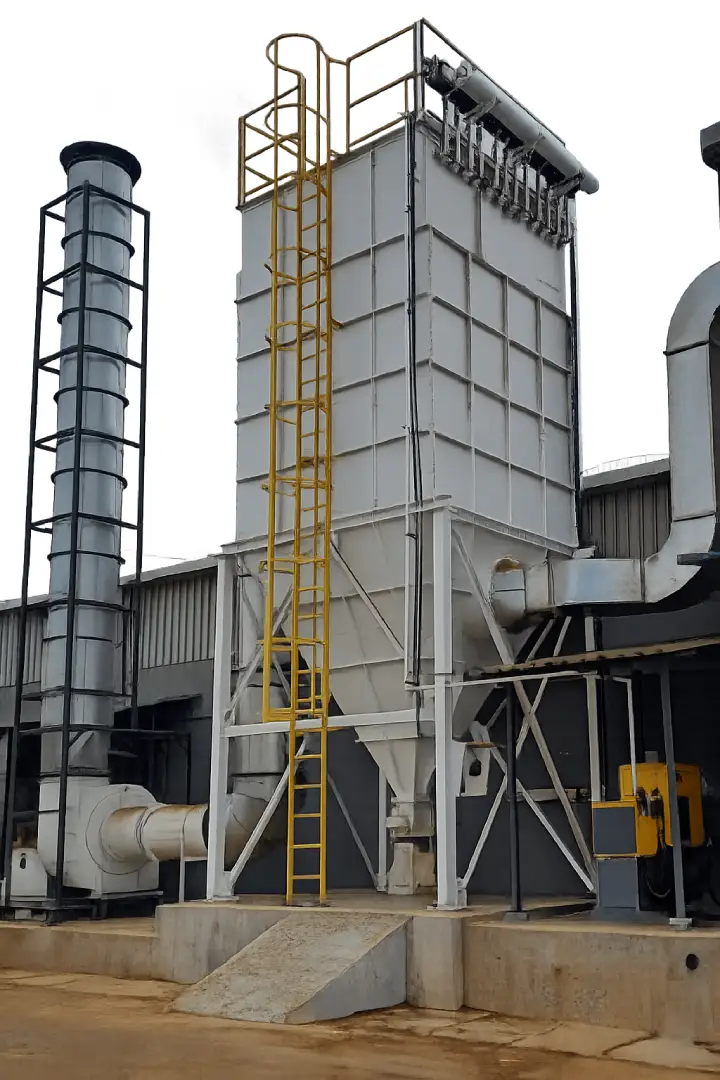

Dust Extraction System
Purevent dust collecters extracts the dusty air from the dusty generating point through duct connected to the bag house. The bags are usually made of cotton, wool, synthetic, or glass fibers, and there may be hundreds of bags within one structure. This kind of fabric filtration is a well-known and practiced method for separating dry particles from a stream of gases /dust. The dusty gas flows into and through the fabric, leaving the dust on the inside of the bag, while the cleaned gas/dust exits through the bag to the other side and then out the baghouse. There are many different types of fabrics, different sizes of bags, different ways of flowing the gases through the bags, and different ways of cleaning the bags within the bag-house. Extended operation of a bag-house requires that the bags be periodically cleaned, and that the dust be removed from the baghouse. The three common types of bag-houses (based on cleaning methods) are shaker, reverse-air, and pulsejet bag-houses. In a shaker bag-house, the dusty airflow is blocked from the compartment to be cleaned, and the bags are shaken to knock off the dust. In a reverse-air bag-house, the dusty airflow is blocked from the compartment to be cleaned, and the clean air is forced to flow gently backwards through the bags, dislodging the particles. In a pulsejet bag-house, a blast of compressed clean air flows briefly into the bags, while they are still filtering dusty air, knocking off some dust. In all cases the dislodged chunks of dust fall by gravity and is collected in hoppers, and can be removed without further disturbing the air filtering process.
Advantages of bag-houses
- High collection efficiencies even for very small particles.
- Can operate on a wide variety of dust concentration.
- Modular in design and construction; modules can be manufactured in the factory and assembled in the field.